Artistic path of the 12 bridges
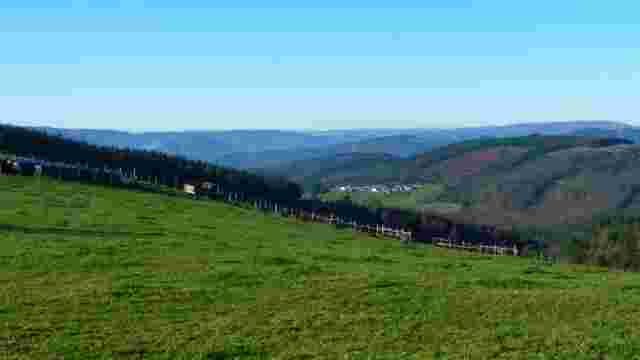
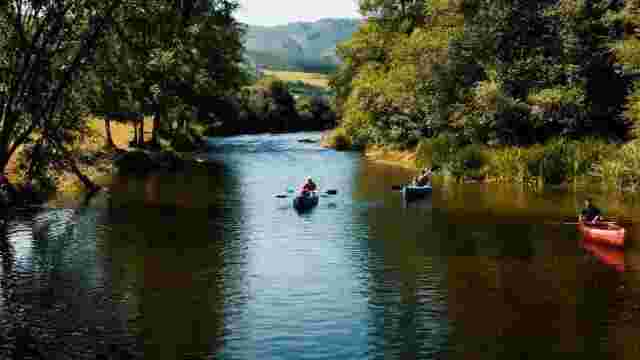
The twelve bridges that cross the rivers Monjardín and Suarón have become a distinctive sign of the town of Vegadeo. They are, at the same time, symbols of union and rapprochement between the different neighbourhoods that make up the town and places of transit from which the people of Vegadeo watch the flow of rivers that are an indissoluble part of their culture. For this reason, the idea was to reinforce its role as a point of attraction for all those who come to the town, creating a kind of path that allows the visitor to walk along them, while enjoying the contemplation of artistic elements that, in a way, summarise the work of a good handful of Asturian plastic artists and, to a large extent, those linked to the west of Asturias. This is how "La senda de los doce puentes" was born, an open-air museum project that aims to combine two fundamental purposes: to be an incentive for people from abroad to come and get to know us, and to show the enormous wealth and quality of contemporary Asturian art. Walking along the waters of the Suarón and Monjardín rivers is a double pleasure: strolling through Vegadeo, the town of the twelve bridges, and enjoying the artistic emotion while listening to the murmur of the waters.
There are currently 7 sculptures:
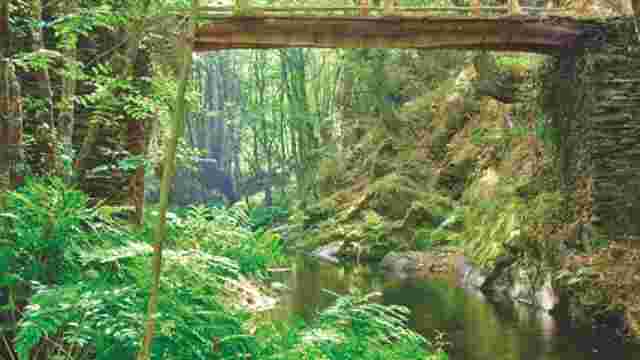
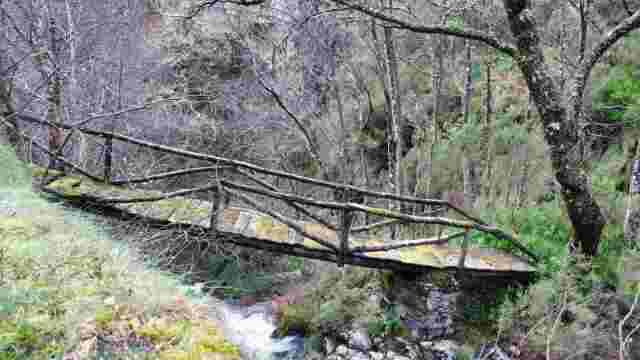
We begin our visit at the first bridge over the Monjardin River: the Puentin de Ferreira. The work installed there, of the same name as the bridge, gathers 7 slate slabs that cover one of the sides, 3 of them engraved with different plant motifs. Its author, M.' Jesús Rodríguez (Oviedo/Uviéu), chose this bridge because it was the only rural bridge left in Vegadeo and because it is located "at one of the ends of the town, between the city and the countryside".
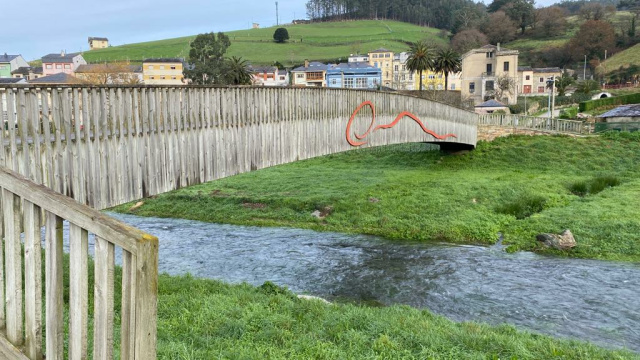
The Travesias Bridge, located to the side of the fairgrounds, is the next stop on the route. In it, Ricardo Monjardín (Boal/Bual) installed a sculpture in which he left several messages in 22 oval pieces placed along the entire structure of the bridge, which simulate the scales of a fish. All of them make up the Pontepeixe work .
The next landmark, the Fondrigo Bridge, brings together two sculptures by the artist Francisco Fresno (Villaviciosa). The first is called Del Tiempo (Of Time) and is a prism of Corten steel with concavities and hollows that represent the wear and tear produced by the passage of time. The second was carried out two years later due to the poor state of conservation of the bridge, and consisted of replacing the old parapets of the bridge with double openwork lattices. Both sculptures are made of the same material and have the same oval holes.
We continue along the path with the bridges over the river Suarón. The first one we come across is the Puente del iviatadero, next to which we can contemplate the sculpture Arboladura, a large mural of almost 3 x 5 metres with which the sculptor José Legazpi (A Veiga/Vegadeo) wanted to pay homage to the riverside carpenters, representatives of one of the traditional trades of this village.
On the Reguero Bridge we can contemplate the work by Herminio (A Caridá) entitled Rotura en el espacio (Break in Space). It is made up of a square section steel bar with two deep cuts in which the bar folds causing a composition of three elements arranged in an apparently impossible balance from any angle.
We continue towards A Abraira Bridge, where the Abrazo sculpture awaits us, a quadrangular geometric piece, one metre long and intensely blue in colour, by the artist Luis Fega, born in Piantón, in the municipality of Vegadeo. This work, as its title indicates, embraces and frames different landscapes of the surroundings, whether they are white buildings or green mounds, depending on where you look from.
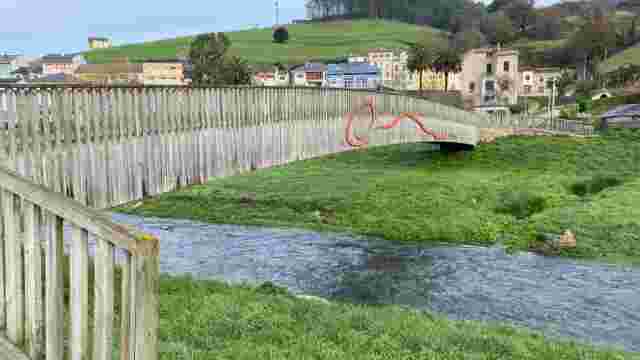
Continuing along the Paseo de Cesar Montaña, which leads us to the Vegadeo Recreational Area, we find the sculpture Vida on the Entreseca Bridge. It is a work of 20 metres long and of an intense red colour that develops along the bridge using one of the parapets as a support. According to its author, Vicente Pastor (Luarca), this sculpture reflects "the natural world and the human world forced to coexist".
The work of César Montaña (A Veiga/Vegadeo, 1928-Madrid, 2000), one of the great names in Spanish sculpture in the second half of the 20th century, also has a prominent presence in Vegadeo, as could not be otherwise. And, although he does not belong to the path as such, it is possible and highly recommendable to visit three of his magnificent works along the way:
The Blacksmith: located in the Elisa and Luis Villamil Secondary School, and which represents one of the traditional trades of the Oscos-Eo region, iron working.
Reading in Penarronda: this is a sculpture located in the Plaza de la Llanera, in Calle del Sur, which represents a woman lying on the sand of Penarronda beach reading a book. It is a work cast in bronze from a plaster mould that was in his workshop.
The Venus Algálica del Eo: located in Medal Park, in the centre of Vegadeo, and made in homage to the writer Álvaro Fernández Suárez and his little fairytale country.
Lastly, in the Town Hall square there is a fountain that in reality could well be another sculptural work. It is a representation of L'Eté (Summer, in French), a reproduction of a work by the French sculptor Mathurin Moreau, located on an iron fountain. The sculpture depicts a young adolescent boy, wearing a short tunic and a cape hanging over his left shoulder, holding a sickle and a rake in his hands, an allegorical representation of summer.